JP.V: Ancient Modernity - The Downfall of the Ancient
- Jun 15, 2023
- 3 min read
Updated: Jun 15, 2023
So far, we have investigated the traditional relics of Japan both in terms of physical and social, as well as addressing their continued relevance in the modern world. As this blog series reaches its ending journey, however, it would be a refreshing change to review and document the decreasing trend of certain ancient customs, ultimately assessing the underlying reasons for their downfall and the impact it has on the Japanese identity.

A panoramic sketch of the Osaka-Namba area. The essence of a traditional Japanese landscape has been swiped off significantly, leaving "tradition" to now only exist in symbolic graphics, hanging off the cold concrete facade of modern buildings.
To learn about the falling apart of traditional Japanese identity, it is important to discuss the key events and catalytic moments in the history of Japan that essentially laid the foundations for its culture. Beyond the prehistoric hunting-gathering society and the periods of cultural exchange with predominantly Chinese influences, pre-modern Japan's social organization and identity were the consequence of three major events: 1. seven centuries of militant power (1183-1868), 2. three centuries of feudal caste society (1600-1868), and 3. two centuries of isolation from the global world [1]. Throughout the majority of its nation's history, Japan was shaped by the Confucian world order, a strict and conservative moral conduct "codebook" that is still evident nowadays in not just the country's political power structure but also in many of its domestic policies. The fall of the samurai class after the Imperial family regained its power and divine right to rule the nation marked the first turning point of its systematic order. Once a legacy of superior powers, samurai warriors were now left masterless, cast away into isolation, or wandered the countryside. During its two hundred years of domestic lockdown in the 17th and 18th centuries, Japan opted for centralizing its cultural facade, guarding itself against Christian ideology and any Western influences that would jeopardize the political stability of the Emperor. When forced to open its doors once again to the world, Japan was confronted with the shocking technological advancement that the Western hemisphere had achieved. It was left humble, standing at the crossroads of a hybrid identity.
The rather inexperienced international power Japan, sensing a viable economic and technological development, nourished the hunger for a new, foreign, and global identity. Tempered by both a sense of inferiority and superiority, Japan was embroiled in its role as a capitalistic and imperialistic nation, incorporating for the first time the democratic social institutions of the West and following in its footsteps to become a colonial power. The people of Japan voluntarily and involuntarily sacrificed themselves for the war effort, pleading their absolute allegiance and subjugation to the will of the Emperor - one that would eventually cost the Imperial family and the general Japanese politics the trust of their people after its unconditional surrender to the Allied military forces. Evidently, research has shown its lasting effect in today's world: out of more than 122 million Japanese citizens, only approximately 7% trust the government, and not even half of them were satisfied with the way democracy is working in their country [2]. Interestingly, a deeper dissection into the percentage shows that within the age group from 30 to 49, 50% were dissatisfied, and 48% from ages 50 and older are also feeling uneasy. Only a small 1/3 fraction of those ages 18 to 29 are displeased. The government's past-time manipulation and censorship of its people during the warring period have left a rather bad image in their minds not just on the idea of authoritarian power but also on the concept of the traditional world as a whole.
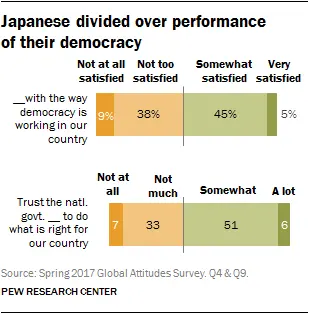
A research chart showing the percentage of different Japanese opinions when asked about their government.
During my visit to the Kyoto Manga Museum, I had a chance to witness the unintentional documentation of the fall of the Japanese traditional world. Once a junior high school, the Kyoto Manga Museum still has a small room, dedicated to keeping and preserving the historical records of the former school. There were countless artifacts exhibited, yet one of which caught my attention the most: a series of the school principals' photos. Every era passed by, and every new principal took his picture, the worn clothes became less and less traditional, until eventually there is nothing but a normal Western suit. For the contemporary Japanese education system at the time, the message was clear: trading in old identities came with the promise of a better life under the European ideology of rationality and enlightenment.

Another series of photos of the former school, taken during the early 20th century, showing the slowly but surely Westernizing process of Japan's modernity (clocks, glass windows, curtains, blackboard, and radio station).
Word Count: 707 words
Citation:
1. “Forming a National Identity" University of Pittsburgh, https://www.japanpitt.pitt.edu/essays-and-articles/society/forming-national-identity
2. "Mixed feelings on Japan's democracy" Pew Research, https://www.pewresearch.org/global/2017/10/17/mixed-feelings-on-japans-democracy/


Comments