JP.IV: Ancient Modernity - Ancient & Modern Conversation
- Jun 14, 2023
- 4 min read
Updated: Jun 14, 2023

A playful skincare advertisement, perfectly exemplifies the harmonious blend of tradition and modernity in contemporary Japan. 06/2023
Beyond our discoveries of traces regarding surviving historical identities and customs in modern Japan, it is crucial to have a conversation with the people themselves and analyze why their cultural context still remains so pervasive and relevant during contemporary times. Essentially, this specific blog will be dedicated to capturing the domestic mindset regarding traditions as well as the continuing foreign adoration for said traditions.

Photos of two contrasting scenery, yet ironically evoking similar feelings. Perhaps one was made in the image of the other. 06/2023
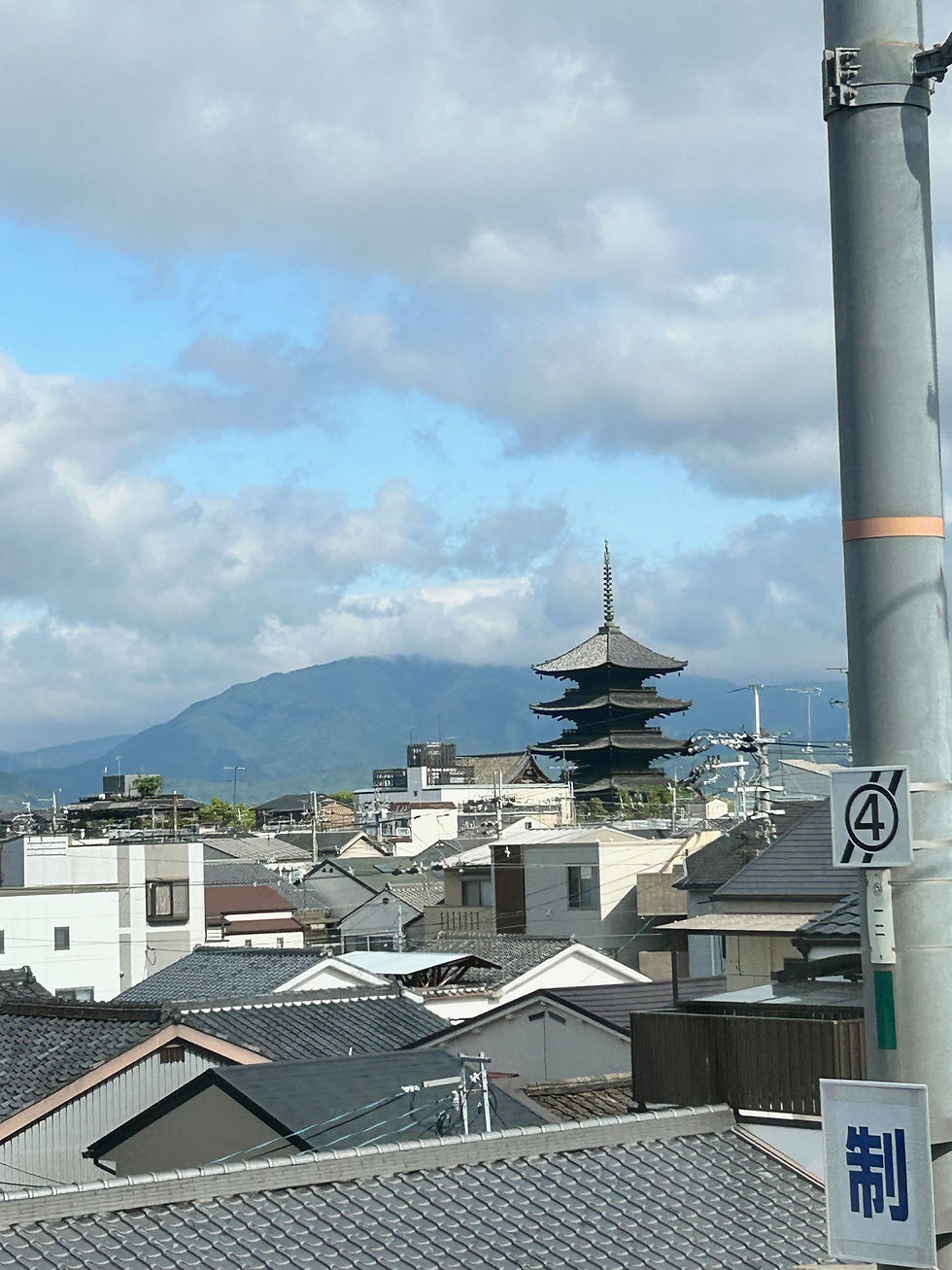
In this context, the word "ancient" needs to be used and interpreted in a rather vague and flexible manner. Culturally, the world as a whole gives characteristics of something to the "ancient" label when mentioning its existence in a time long past, usually in remote ages; the old and the antique [1]. On the opposite side, its antonym, "contemporary," signifies relevance, modernity, and of the present age [2]. These two words often do not exist together in not just one sentence but also not in any one timeline simultaneously; for a person to embrace one means to turn their back on the other. To us, ancientness equates lostness and outdated. To the Japanese, however, their ancient time has never really ended. Even in a literal and symbolic sense, the governmental structure of Japan still includes its feudalistic imperial system as the face of the nation. And as discussed previously in other blogs, countless traditions of Japan since the prehistoric eras are still celebrated and endorsed across the country and beyond. After World War II and recognizing the obvious progressions of the Industrial Revolution, many countries in the world sided with Modernity and Westernized to wash away their own national identity, tradition, and culture. Japan was one of the few that had chosen both. For them, modernity and tradition are not the two end strings in the tug-of-war, but rather two fishes swimming in the same pond: they could choose to make one bite the other or to create a thriving environment for them to coexist harmoniously with one another. With such intertwines it is no strange scene to walk down a street in Japan and see people wearing kimonos and geta, meanwhile browsing on their mobile devices or consuming Starbucks and McDonald's.

Though mimicking the design language of traditional paper lamps, these steel streetlights bear a certain coldness. Lacking the fire in a literal sense.
There are many reasons why this boundary separating the tradition and the new is so obscured in Japan, but one that stands out the most is their capability to adapt to changes. One of the predominant concepts of philosophy in Japan is "wabi-sabi." Wabi-sabi is the perception of appreciating beauty in every aspect of life as well as its imperfect and impermanent nature [3]. For instance, in many traditional homes in Japan, the presence of green algae growing on their stone railings, or the cracks and fading of wood stains on the columns signifies not the damage to the house but rather elevates its value by indicating how much it has withstood time and weather. From a wabi-sabi perspective, change is the only constant. Nothing demonstrates this mindset better than their ability to recover back to the pre-war economic level within only ten years after World War II (1945) [4]. During my time visiting Japan, I had the honor to converse with Tomei-sensei, a representative from the Kyoto University of Foreign Studies. Being a member of the older generation, Tomei-sensei's life has spanned many eventful marks of Japanese modern history. He was there when Japan had just recovered from the post-war Great Depression in mid-century. He was there when the Kyoto Municipal Subway founded its own bureau and started its Karasuma Line operation in the 1980s. And he was also there when the Nippon Telegraph and Telephone (NTT) launched the world's first first-generation mobile phone service (1G) in 1999. Tomei-sensei has seen the progression of Japan both economically as a country and culturally as a society. When asked about whether or not he felt overwhelmed by the speed of technological advancement, from pure paperwork at a desk to now an AI at the tip of his finger, Tomei-sensei admitted that it is "almost too fast to catch up." But as the world moves on, so do we, he said. Japan is currently a leader in various fields of technology, yet at the same time, it is also a pioneering flag holder in cultural and heritage preservation. It has proved to us time and time again that modernity complements tradition, not compromises it. Sometimes, to move forward, you have to look back.
Word Count: 727 words
Citation:
1. “Ancient." Wiktionary, https://en.wiktionary.org/wiki/ancient#:~:text=Existent%20or%20occurring%20in%20time,time%20before%20the%20Middle%20Ages.
2. "Contemporary." Wiktionary, https://en.wiktionary.org/wiki/contemporary
3. “Why Is It Difficult to Understand What Wabi-Sabi Means?: Kyoto Inn & Tour.” KYOTO Inn&Tour, 20 Jan. 2020, www.kyoto-ryokan-sakura.com/archives/191#:~:text=The%20definition%20of%20wabi%2Dsabi,%2C%20impermanent%2C%20and%20incomplete%E2%80%9D.
4. Japanese Modernization Lecture Series Chapter 9 ... - Jica, www.jica.go.jp/dsp-chair/english/chair/modernization/ku57pq00002mpdct-att/modernization_chapter_09_01.pdf.


Comments